
Table of contents
Hide
Twisted Fiber Bundles
3D Scientific Model of Twisted Fiber Bundles — C4D Source File (RS Rendering)
High-precision 3D models of twisted fiber bundles, with source files in C4D format and rendered using Redshift, realistically reproduce the spiral twists, intertwined patterns, and natural drape of the fiber bundles, enabling scientific visualization in the fields of biomechanics, materials science, and tissue engineering.
📌 Model Overview
Fiber bundle structures are widely found in both natural and man-made materials—from collagen fibers in bones, muscle fiber bundles in muscle tissue, and axon bundles in nerve bundles, to vascular bundles in plant stems, reinforcing fibers in composite materials, and yarn structures in textile materials. the arrangement and spatial configuration of fiber bundles directly influence a material’s mechanical properties, transport functions, and biological behavior. Among these,Twist Helical winding is one of the most common spatial arrangements of fiber bundles; it imparts unique flexibility, tensile strength, and structural stability to the fiber bundles.
This model uses C4D (Cinema 4D) A three-dimensional structure consisting of a bundle of fibers in a naturally twisted state was constructed using Redshift (RS) renderer The rendering of materials and lighting has been completed, accurately recreating the realistic appearance of multiple fibers intertwined, spiraling, and alternating in density. The model can be used as Figures in SCI Papers、Academic Presentation Key visual assets that can also be used for Visualization of Biomechanical Simulations、Material Structure Display 及 Science Education Demonstration... is a high-quality 3D resource in the fields of biomechanics, tissue engineering, and materials science.
✨ Key Highlights
🌀 Distorted shapes, natural and lifelike
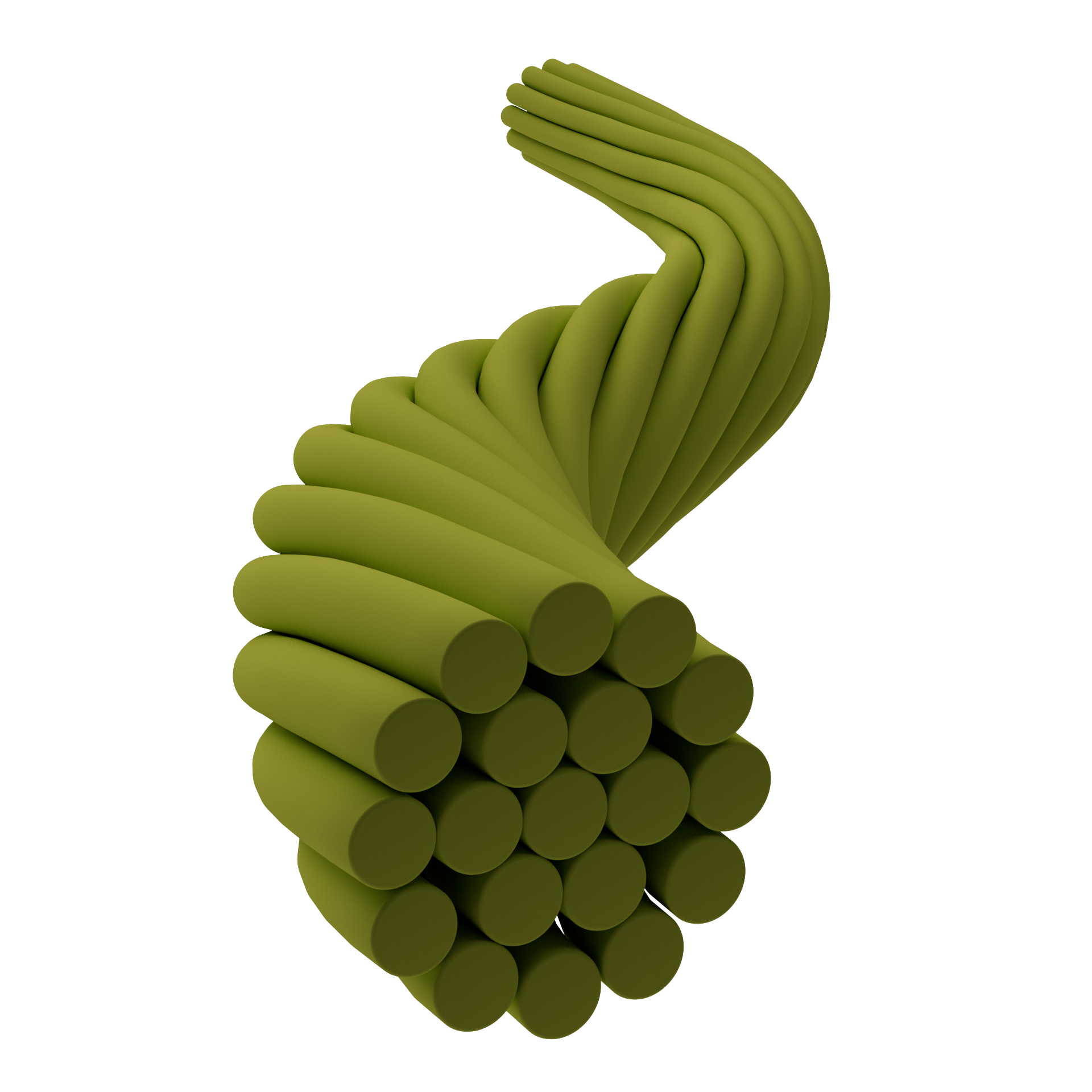
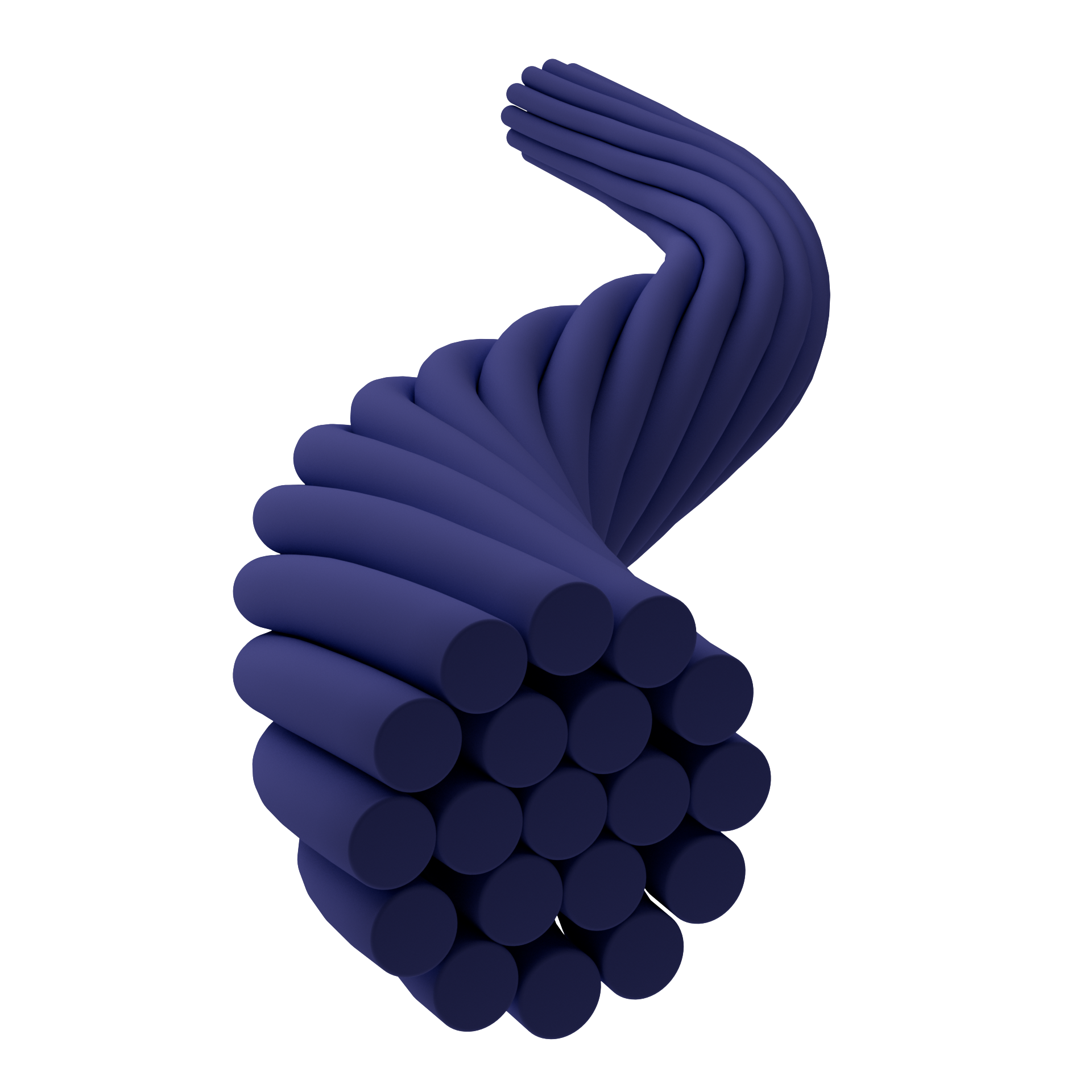
The core feature of the model lies in the fiber bundles'Spiral Twisted Structure: Multiple fibers are spirally wound along the axis of the bundle; while the fibers intersect at regular angles, they also retain natural, random fluctuations, creating an overall sense of dynamic, twisted rhythm and three-dimensional depth. The ends of the fibers fan out naturally, with some fibers exhibiting slight drooping and curvature, resulting in a realistic and believable form.
🌾 Rich in structural layers and full of detail
The model incorporates a complete hierarchy of fiber bundle structures: from the cylindrical shape and surface texture of individual fibers, to the grouped winding of fiber bundles, to the overall bundle contour—each level has been meticulously constructed. The spacing between fibers, the tightness of the winding, and the twist period have all been optimally adjusted to suit a variety of display scenarios, from close-ups to panoramic views.
🎨 Professional rendering with outstanding texture
With the help of Redshift GPU-accelerated renderer...The model features two carefully crafted material presets—one with the texture of biological tissue and the other with the texture of synthetic fibers—allowing users to choose between the soft luster and translucency of collagen fibers or the high-strength, industrial look of synthetic fibers. The multi-angle lighting system perfectly highlights the three-dimensional layering, interplay of shadows, and surface details of the fiber bundles.
📁 Source files are open and free to edit.
We provide a complete C4D project file, including all material node networks, lighting systems, multiple camera angles, and rendering presets. You can freely adjust the degree of distortion, the number and thickness of the fiber bundles, the color scheme, and the material parameters as needed. You can also create animations showing the fiber bundles stretching, twisting, or breaking.
🔄 Ready to use right out of the box, suitable for a variety of scenarios
Whether it’s a schematic diagram of the microstructure of biological tissues, a visualization of the reinforcement mechanisms in composite materials, or an analysis of fiber orientation in engineering mechanics, this model can be quickly adapted. It’s ready to use right out of the box, significantly reducing modeling time.
📋 Technical Specifications
| Project | Specifications |
|---|---|
| Structural Types | Multi-fiber helically twisted bundle structure |
| software format | C4D (.c4d) |
| renderer | Redshift (RS) |
| Output Resolution | 4K Ultra HD (output can be customized to a higher resolution) |
| Document Content | 3D Models + Complete Materials (Multiple Versions) + Lighting System + Camera Presets |
| Attached file | Multi-angle rendering previews (PNG format) |
| Applicable software | Cinema 4D R20 or later (Redshift 3.0+ recommended) |
| Applicable scenarios | Illustrations for academic papers, cover design, PowerPoint presentations, animation production, and science outreach exhibits |
🎯 Use Cases
- Microstructure of Biological Tissues: Illustration of the spatial arrangement of collagen fiber bundles, muscle fiber bundles, and nerve fiber bundles
- Materials Science and Engineering: Fiber Reinforcement Mechanisms in Composite Materials, Structural Analysis of Textile Materials
- Biomechanics and Tissue Engineering: Demonstration of the fiber structure and textural anisotropy of the scaffold material
- Earth Science: Microstructure of Mineral Fibers and Natural Fiber Materials
- Science Visualization: A Comparison of Natural and Synthetic Fibers
👥 Target Audience
- Biomechanics, Tissue EngineeringResearchers and graduate students in the field
- Materials Science and EngineeringResearchers in the field
- Engage inComposite Materials—Biomaterials—Textile MaterialsThe team conducting related research
- Needs to be madeSchematic Diagram of Fiber Structureacademics
- Scientific visualization designerand 3D modeling enthusiasts
- Creator of journal covers, illustrated abstracts, grant proposals, and science outreach displays
🖼️ Preview display
This material is suitable for biochemistry scientific research, featuring high resolution. It was created using C4D (CINEMA 4D) software with the RS (RedShift) renderer. It is recommended to open this material with C4D, where you can freely adjust the model colors, display orientation, and other settings.
📥 How to Get It
Since digital products are considered special virtual items, refunds or exchanges are generally not permitted once they have been unlocked and downloaded. Please carefully review the type of product and terms of use before making a purchase.
Image assets only include PNG format
The source files include image assets, C4D format source files, and GLTF format files. The 3D source files need to be opened with C4D software, please confirm yours.Software version is greater than or equal to R20, too low of a Cinema 4D version might not be able to open it
You can achieve results consistent with this site by using the RedShift renderer. Other renderers can also be used, but due to differences in renderers and materials, the output will vary and you will need to adjust the materials and lighting according to your specific renderer.
Usage tips: To ensure optimal rendering results, please make sure your versions of C4D and Redshift are compatible. This resource is intended solely for academic research and personal study; it may not be used for commercial purposes without authorization.
Method 1
Creating artwork is no easy task,Stock ImagesPacked in the cloud drive, pay to unlock or upgrade to a junior or higher membership to download. Membership information can be found atIntroduction to the XC Membership System. Before paying, please make sure you understand the details of the above materials andDisclaimer of this site。
Files shared via cloud storage: Link to image assets of twisted fiber bundles:
 Basic Member
 Intermediate member
 Premium member
Source file materialPay to unlock or upgrade to an intermediate or higher membership to download.
Method 2
ClickLinkGet materials.
💬 About this model
The challenge in modeling twisted fiber bundles lies in achieving a natural, uniform spiral winding effect while maintaining the independence of each individual fiber. Simple arrays and twisting deformations often result in fibers intertwining or penetrating one another, which undermines realism. During the construction of this model, a variety of techniques—including path deformation, cloning, and randomization—were comprehensively applied. After repeatedly adjusting the fibers’ initial phase, twist amplitude, and radial distribution, the ideal result was ultimately achieved: fibers that do not intersect and exhibit a natural winding rhythm. At the same time, the model effectively manages the number of polygons while preserving rich detail, ensuring efficient rendering in the Redshift renderer.
We are committed to providing the scientific community with high-quality 3D visualization resources. If you have any questions about the models or need custom models of other fiber/bundle structures (such as parallel fiber bundles, woven structures, branched fiber networks, etc.), please feel free to contact us at any time. We are continuously updating our collection of scientific resources—stay tuned!
Make the visualization of fiber structures clearer and more vivid. 🌀✨