Table of contents
Hide
3D scientific research model of nanowire spheres

🧶 3D Scientific Model of Nanowire Spheres — C4DSource file (RS(Rendering)
High-precision 3D model of an interconnected nanowire spherical network, C4D format source file.RedshiftThe rendering vividly reproduces the three-dimensional winding topology of nanowires and the surface functionalized particle modification. A purple/blue dual-color version is available, empowering scientific research visualization in the fields of nanomaterials, energy storage, and catalysis.
📌 Model Overview
Nanowire Ball / Nanowire Sphere It is a three-dimensional spherical porous network structure formed by the interweaving, winding, and self-assembly of one-dimensional nanowires. This unique topological configuration not only retains the extremely high aspect ratio and excellent electron transport capability of the nanowires themselves, but also provides an ultra-high specific surface area, rich pore structure, and excellent fluid permeability through its macroscopic spherical morphology.
In the fields of materials science and chemistry, nanowire spheres...Lithium-ion battery anode materials, electrocatalytic oxygen evolution/hydrogen evolution reaction (OER/HER), supercapacitors, gas sensorsandHigh-efficiency adsorption materialsThey demonstrate great application potential in various fields, especially in catalysis, where the surface of nanowire networks often needs to be loaded with...Metal nanoparticles (such as Pt, Au, etc.) or quantum dotsAs catalytically active sites, they can achieve synergistic catalytic effects.
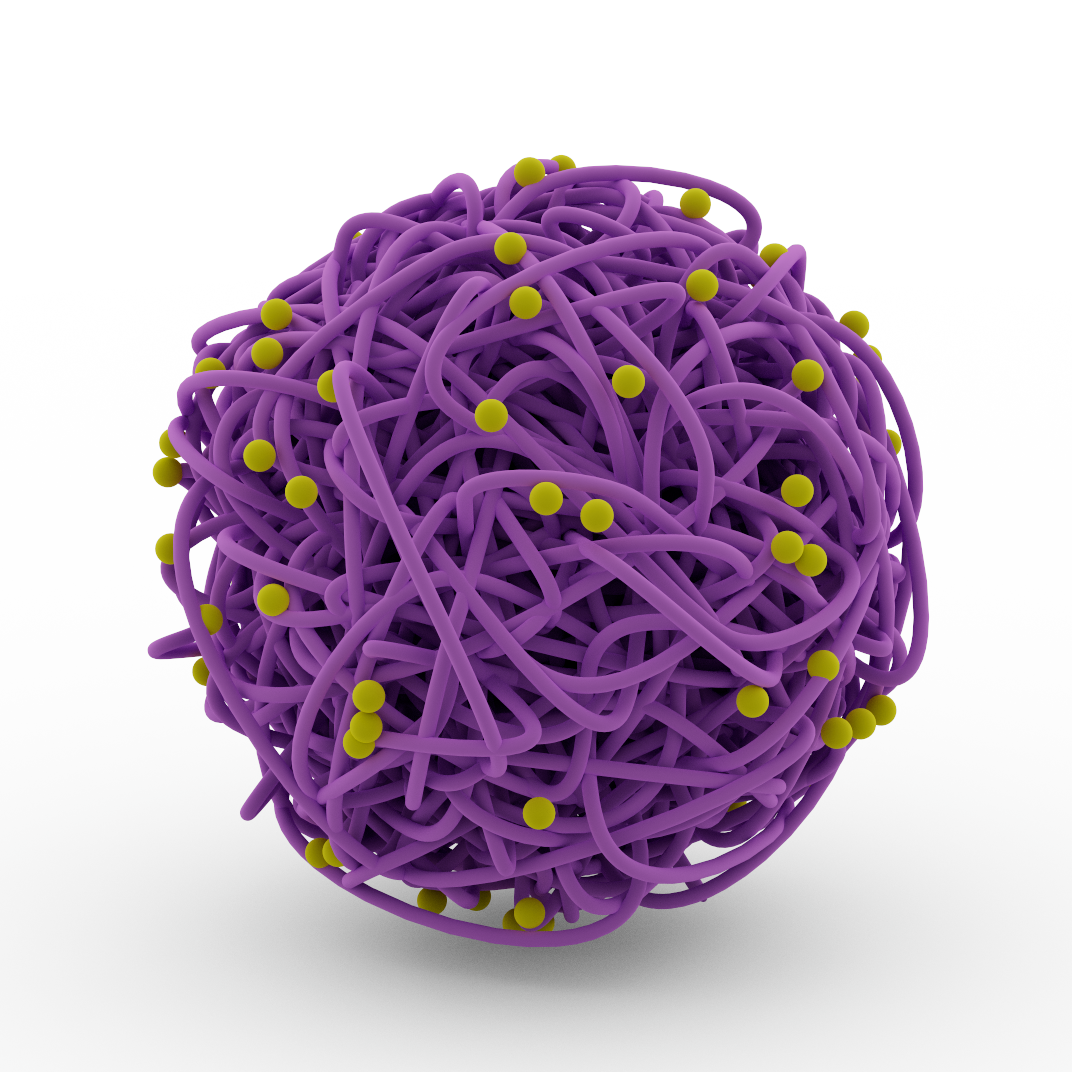
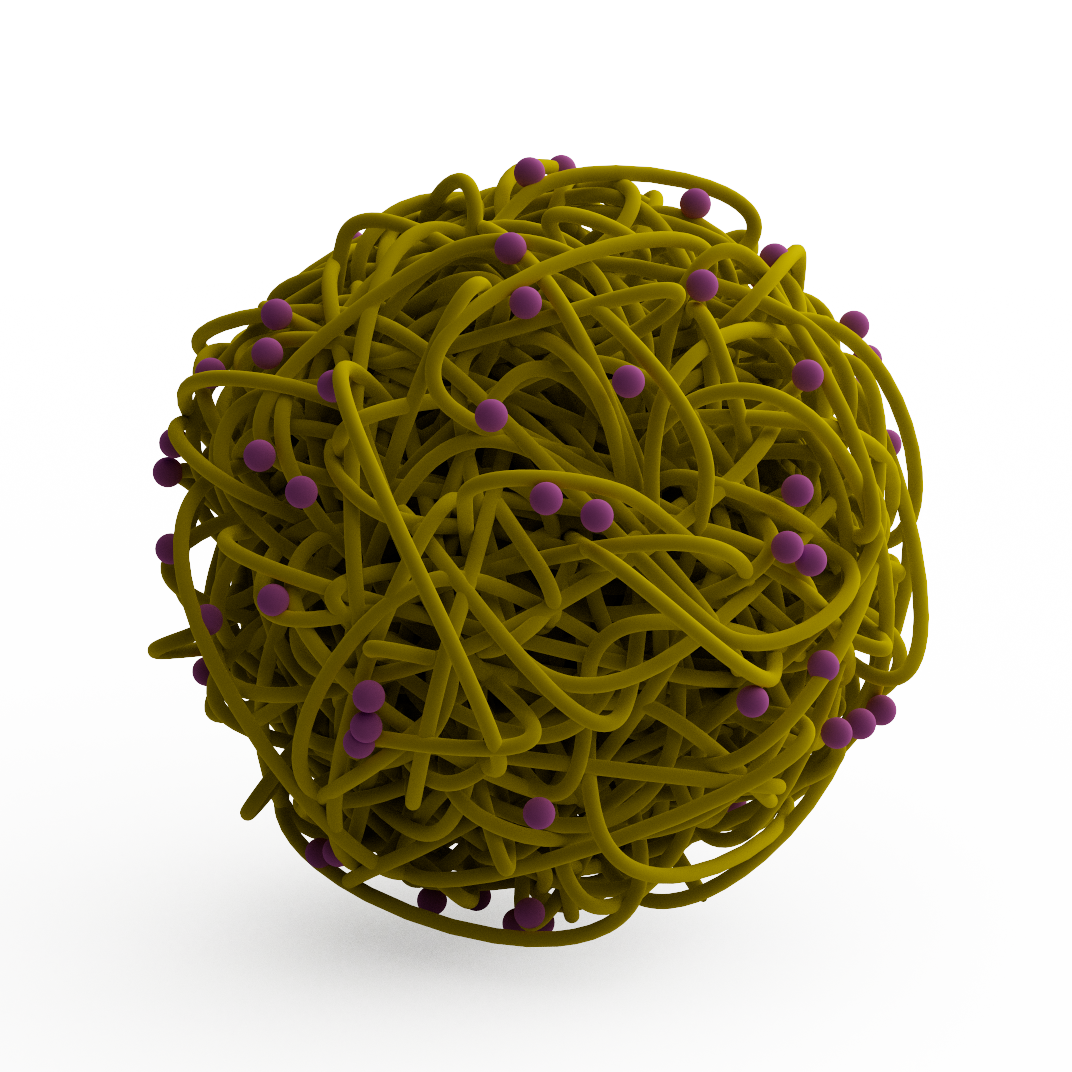
This model uses C4D (Cinema 4D) An extremely complex nanowire winding network structure was constructed, using Redshift (RS) renderer Complete the material and lighting rendering. The model accurately reproduces the crisscrossing linear skeleton, with random distribution of materials on its surface and within the network.spherical particlesThis vividly illustrates the surface modification and loading of nanoparticles. The model offers various color and material variations, all of which can be freely switched in the source files. This model belongs to this site's “Scientific research model series”It is consistent in style with porous microspheres, core-shell spheres, MOFs and other models, and can be used in conjunction with them.
✨ Key Highlights
🌐 Complex topology, precisely constructed
While nanowire spheres may appear chaotic, they actually require extremely precise geometric calculations. The model, through a combination of procedural generation and manual fine-tuning, constructs a highly realistic three-dimensional interwoven network. The wires are of uniform thickness, with natural curvature, tight interconnections, and no sense of mold breaking, perfectly replicating the macroscopic morphology of nanowire spheres prepared by hydrothermal or self-assembly methods.
🟡 Surface finishing, vivid details
Fine particles are evenly distributed on the interwoven network of the model's surface and interior.Yellow sphereThese particles vividly illustrate the role of composite structures.Metal nanoparticle loading或Catalytic active sitesThe transition between particles and lines is natural, intuitively demonstrating the heterogeneous structural features of “one-dimensional substrate + zero-dimensional particles”.
🎨 Multiple colors, switch freely
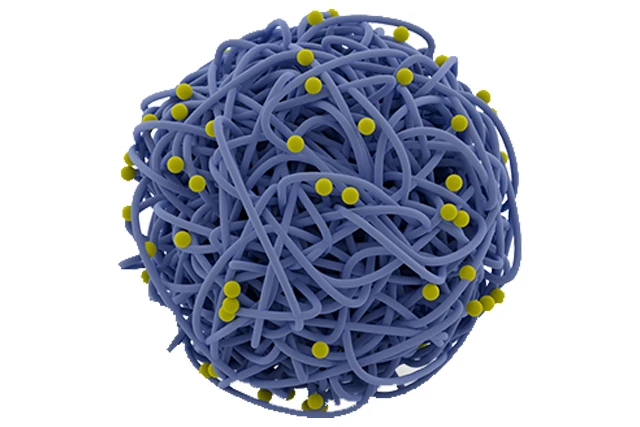
Example models are providedPurple与blueTwo material versions are available. The purple version offers striking contrast, perfect for highlighting the visual presence of surface particles; the blue version exudes a sophisticated, tech-inspired feel with a unique cool tone, suitable for diagrams related to energy and electronic components. You can change the material sphere at any time in the source file to suit different layout needs.
✨ Redshift professional rendering, with outstanding texture quality
With the help of Redshift GPU-accelerated rendererThe model was meticulously crafted with a slightly elastic matte material texture. The multi-angle lighting system not only penetrates the pores of the nanowire network, making the internal structure clearly visible, but also creates rich shadow layers between the intersecting lines, perfectly presenting the three-dimensionality and spatial depth of the entire porous sphere.
📁 Source files are open and free to edit.
It provides complete C4D project files, including all material nodes, lighting systems, and camera presets. Because the nanowire network is composed of a large number of curved objects, you can freely adjust the number of wires, winding density, wire diameter, and also change the size and distribution of surface particles, and even create dynamic animations of sphere rotation or particle desorption.
📋 Technical Specifications
| Project | Specifications |
|---|---|
| Model Type | Nanowire interwoven spherical network (with surface particle modification) |
| Structural Features | Three-dimensional interconnected linear network + spherical particles with surface/internal load |
| Color version | Purple version / Blue version (both are included in the source files; colors can be adjusted freely). |
| Material Options | The fabric has a matte finish, while the particles have a slightly glossy, composite texture. |
| software format | C4D (.c4d) |
| renderer | Redshift (RS) |
| Output Resolution | 4K Ultra HD (output can be customized to a higher resolution) |
| Document Content | 3D Models + Complete Materials + Lighting System + Camera Presets |
| Attached file | Multi-angle rendering previews (PNG format) |
| Applicable software | Cinema 4D R20 or later (Redshift 3.0+ recommended) |
| Series Attribution | This website's “Scientific Research Model Series” |
| Applicable scenarios | Paper illustrations, cover design, PPT presentations, animation production, teaching materials |
🎯 Use Cases
- Electrocatalysis and energy storageSchematic diagram of nanowire spheres as electrode materials (such as lithium battery anodes and supercapacitors).
- Catalyst Design VisualizationThis study demonstrates the synergistic catalytic mechanism of one-dimensional nanowire networks and zero-dimensional metal nanoparticles.
- Gas sensing and adsorption: Schematic diagram of the high specific surface area and porous network of nanowire spheres in gas molecule capture.
- Research on self-assembly of nanomaterialsIt showcases the morphological characteristics of one-dimensional materials evolving into complex three-dimensional macroscopic structures.
- Journal Covers and Abstracts with IllustrationsIts technologically advanced and geometrically beautiful shape can be used as the main visual image for high-level papers.
👥 Target Audience
- Materials science, physical chemistry, nanotechnologyResearchers and graduate students in the field.
- Engage inNew energy materials (batteries, catalysts), sensors, composite materialsThe team conducting the relevant research.
- LectureNanomaterials, Materials Synthesis and PreparationEducators of the curriculum.
- Needs to be madeSchematic diagram of nanostructure morphologyAcademic workers.
- Scientific visualization designerAnd 3D drawing enthusiasts.
🖼️ Preview display
This material is applicable toBiochemistryThis material is from scientific research and features high resolution. It was created using Cinema 4D (C4D) software and rendered using RedShift (RS). It is recommended to open this material in C4D, where you can adjust the model's color, display orientation, and other settings.
📥 How to Get It
Since digital products are considered special virtual items, refunds or exchanges are generally not permitted once they have been unlocked and downloaded. Please carefully review the type of product and terms of use before making a purchase.
Image assets only include PNG format
The source files include image assets, C4D format source files, and GLTF format files. The 3D source files need to be opened with C4D software, please confirm yours.Software version is greater than or equal to R20, too low of a Cinema 4D version might not be able to open it
You can achieve results consistent with this site by using the RedShift renderer. Other renderers can also be used, but due to differences in renderers and materials, the output will vary and you will need to adjust the materials and lighting according to your specific renderer.
Usage tips: To ensure optimal rendering results, please make sure your versions of C4D and Redshift are compatible. This resource is intended solely for academic research and personal study; it may not be used for commercial purposes without authorization.
Creating artwork is no easy task,Stock ImagesPacked in the cloud drive, pay to unlock or upgrade to a junior or higher membership to download. Membership information can be found atIntroduction to the XC Membership System. Before paying, please make sure you understand the details of the above materials andDisclaimer of this site。
Files shared via cloud drive: Nanowire sphere image resource link:
 Basic Member
 Intermediate member
 Premium member
Source file materialPay to unlock or upgrade to an intermediate or higher membership to download.
💬 About this model
The challenge in modeling nanowire spheres lies in achieving “order within chaos.” Depicting the random entanglement of nanowires while avoiding intersecting objects that could disrupt the rendering surface often requires significant time for physical simulations or complex procedural node routing. This model, while maintaining extremely realistic visuals, optimizes the underlying geometry, enabling fast and high-quality rendering in Redshift.
As part of our “Scientific Research Model Series,” this nanowire sphere model fills a gap in the display of one-dimensional/three-dimensional composite material morphology. We are committed to providing high-quality 3D visualization resources for the scientific research community. If you have any questions about the model, or need customization of other complex nanomorphologies (such as nanoflowers, nanorod arrays, etc.), please feel free to contact us. More scientific research resources are being continuously updated, so please stay tuned!
To make the visualization of the microscopic world more vivid and accurate. 🧶✨
Modeled in Cinema 4D | Rendered with Redshift | Part of the Scientific Model Series | Designed for Scientific Visualization