Table of contents
Hide
3D Model of a Zeolite
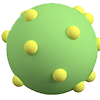
🟢 Type A Zeolite 3D Research Model — C4D Source Files (RS Rendering)
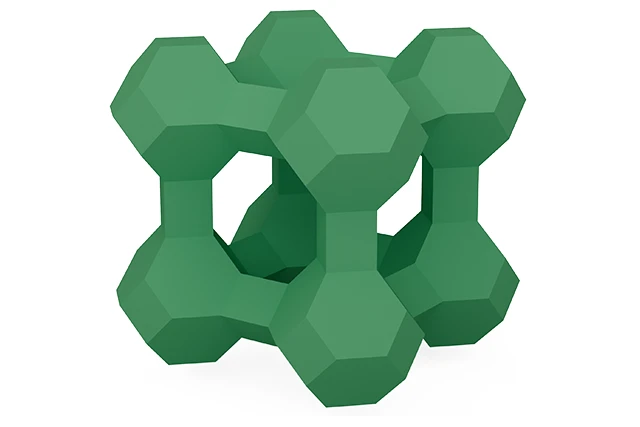
High-precision Type A zeolite (LTA topology) 3D framework model, C4D source file, rendered with Redshift, providing a visual representation of the β-cage —double tetrahedral ring—α-cage, showcasing the three-dimensional interconnected pore channels and the “solid framework + pore cavity” structure, empowering scientific visualization in the fields of catalysis, adsorption and separation, and materials chemistry.
📌 Model Overview
Molecular sieves are a type of hydrated silicoaluminate or natural zeolite—a class of crystalline materials with a regular microporous structure. Their framework consists of TO₄ tetrahedra (where T = Si, Al, P, etc.) connected by shared oxygen atoms, forming a three-dimensional pore network with uniform pore sizes. Thanks to their unique shape-selective properties, excellent ion-exchange capacity, and tunable surface acidity, molecular sieves play an irreplaceable role in fields such as petrochemical catalysis, gas adsorption and separation, environmental remediation, and the synthesis of fine chemicals.
Type A ZeoliteIt is one of the most classic and widely used structural types in the zeolite family and belongs to LTA (Linde Type A) Topology... is a synthetic hydrated silicoaluminate zeolite. Its framework consists of β-Cage (Sodalite Cage, SOD Cage) By Double Tetracyclic Ring (D4R) connected together to form a larger α-cage, forming a three-dimensional, interconnected pore system. The typical pore size of Type A zeolite is approximately 0.4 nm (4 Å), Depending on the type of cation (Na⁺, K⁺, Ca²⁺, etc.), they can be classified into different grades, such as 3A, 4A, and 5A, and are widely used in gas drying, separation and purification, and catalytic reactions.
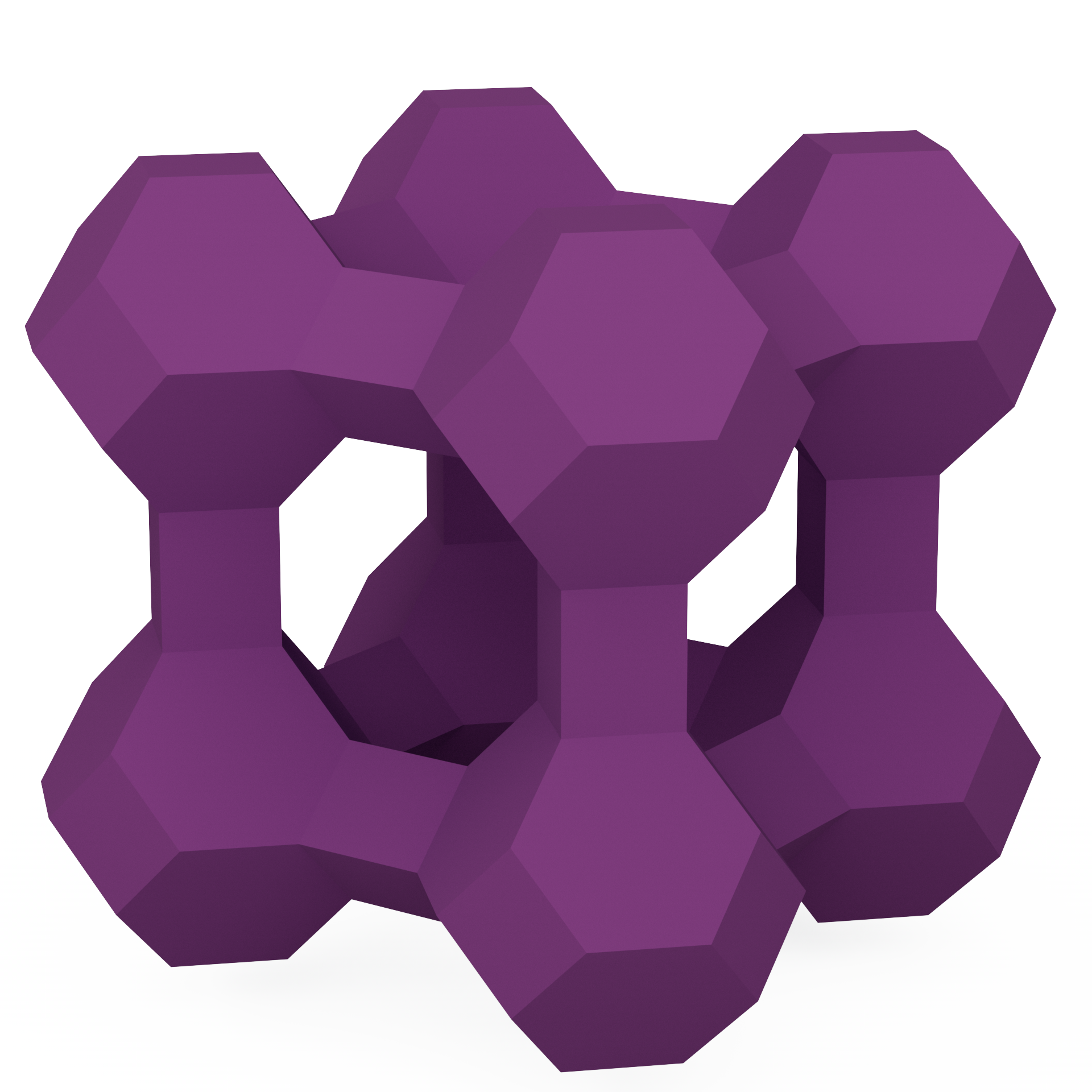
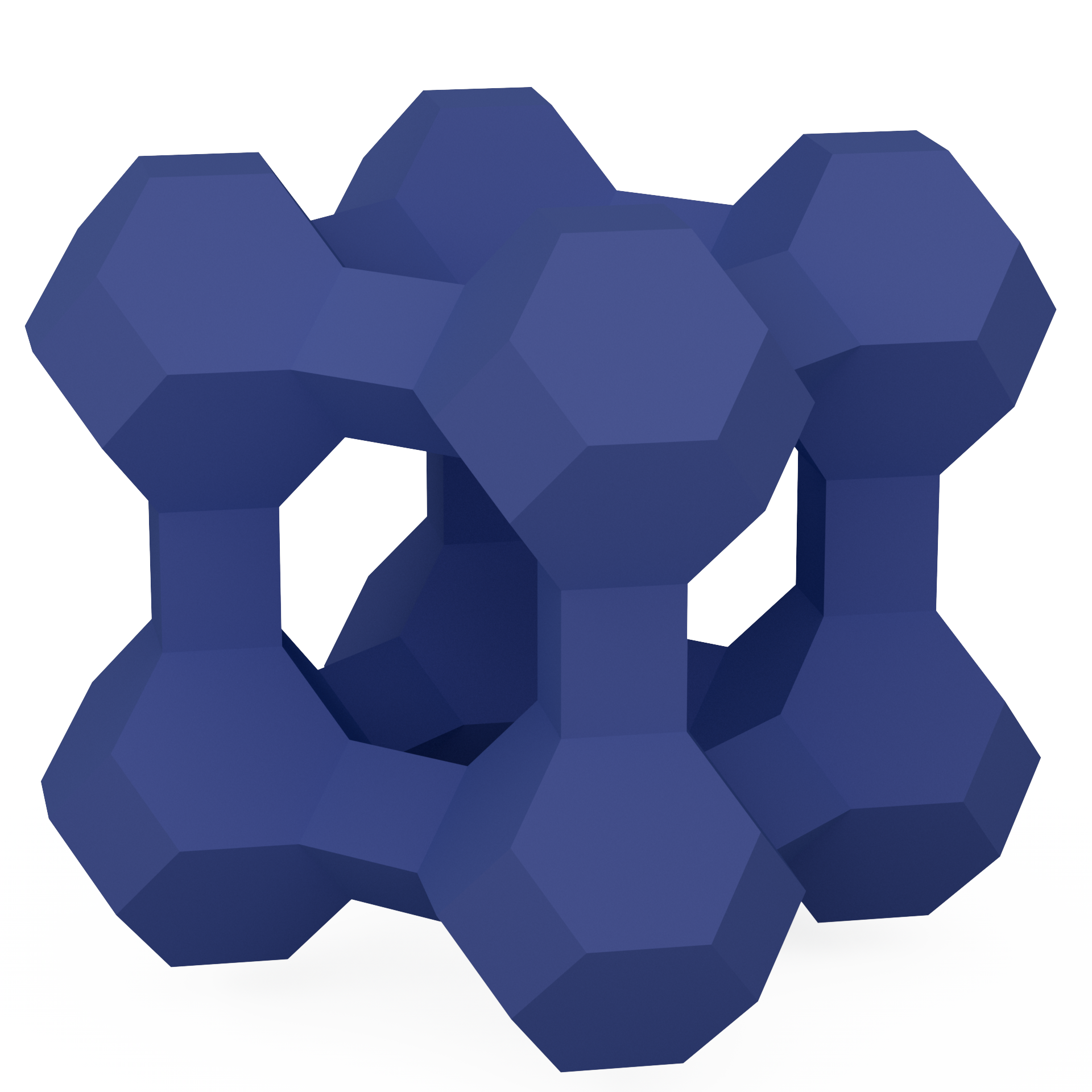
This model uses C4D (Cinema 4D) A general schematic model of a scaffold based on the crystal structure of Type A zeolite was constructed using Redshift (RS) renderer Completed rendering of materials and lighting. The model is based onGreen EntityThis illustrates the framework network of a molecular sieve; the cavities enclosed by the framework represent the molecular sieve’s pore channels or cage structure, providing a visual representation of “Solid Skeleton + Hollow Channels”spatial relationships. Multiple cage-like units are interconnected through passageways, precisely mirroring the assembly logic of β-cages, double tetrahedra, and α-cages in A-type zeolites. The model as a whole presentsLow-Poly Style, with clearly defined geometric boundaries, it is suitable for both the precise representation of scientific diagrams and the visual aesthetics of modern design, and can be used directly in Figures in SCI Papers、Academic Presentation、Fund Application 及 Teaching Demonstration。
✨ Key Highlights
🔬 Type A zeolite structure, precisely reproduced
Based on the crystal structure of Type A molecular sieve (LTA topology), the model intuitively illustrates the structure formed by β-cage By Double Tetracycle Connection Formation α-cage three-dimensional framework characteristics. Each cage unit is connected to other units via cylindrical channels, forming an open three-dimensional pore network. This structural layout precisely mirrors the typical “framework–pore–cavity” spatial relationship of Type A zeolites, enabling readers to quickly understand its mass transfer pathways and site-selective catalytic mechanisms.
🎨 Low-poly style, clean and modern
The model features a low-poly modeling style, with surfaces composed of distinct, flat polygons that are sharply defined yet maintain an overall sense of fluidity. The uniform green color scheme lends the model a calm and professional visual appeal, making it ideal as a central visual element for academic papers, PowerPoint presentations, or science outreach materials.
✨ Redshift professional rendering, with outstanding texture quality
With the help of Redshift GPU-accelerated renderer, We’ve carefully selected a matte-finish material for the model—its surface features soft diffuse reflection and subtle transitions of light and shadow. The multi-angle lighting system perfectly highlights the three-dimensional layers of the cage-like structure, the sense of depth in the passages, and the thickness of the framework. The rendering has no background and can be directly exported as a transparent PNG, making it convenient for post-production compositing.
📁 Source files are open and free to edit.
We provide complete C4D project files, including all material node networks, lighting systems, multiple camera angles, and rendering presets. You can freely adjust the number of cage units, channel length, color schemes, and material parameters as needed, and you can also create animations of molecular diffusion within the channels or scenes featuring multiple cage arrays.
🔄 Ready to use right out of the box, suitable for a variety of scenarios
Whether it’s a schematic diagram of the molecular sieve catalytic mechanism, a demonstration of the gas adsorption and separation process, or teaching materials on porous materials, this model can be quickly adapted. It’s ready to use right out of the box, significantly saving time on modeling and material tweaking.
📋 Technical Specifications
| Project | Specifications |
|---|---|
| Model Type | Schematic Model of the Type A Zeolite (LTA Topology) Framework Structure |
| Chemical Composition | Hydrated silicoaluminates (zeolites) |
| Structural Features | β-Cage (Sodium-Square Cage) + Double Tetrahedral Ring (D4R) + α-Cage + Three-Dimensional Interconnected Channels |
| Topology Type | LTA (Linde Type A) |
| Typical Pore Size | Approximately 0.4 nm (4 Å) |
| Typical Si/Al ratio | ≈ 1 |
| Modeling Style | Low-Poly |
| Primary Color Scheme | Green (customizable) |
| software format | C4D (.c4d) |
| renderer | Redshift (RS) |
| Output Resolution | 4K Ultra HD (output can be customized to a higher resolution) |
| Document Content | 3D Models + Complete Materials + Lighting System + Camera Presets |
| Attached file | Multi-angle rendering previews (PNG format) |
| Applicable software | Cinema 4D R20 or later (Redshift 3.0+ recommended) |
| Applicable scenarios | Illustrations for academic papers, cover design, PowerPoint presentations, animation production, educational courseware, and science outreach exhibits |
🎯 Use Cases
- Visualization of Catalytic Research: Schematic representation of the structure of Type A molecular sieves, showing isomorphous catalysis, acidic sites, and mass transfer pathways
- Adsorption and Separation: Illustration of the pore structure in gas drying, separation and purification, and ion exchange processes
- Petrochemicals: Structural Characteristics of Zeolite Catalysts in Reactions Such as Catalytic Cracking and Isomerization
- Materials Science Education: A 3D Explanation of the Topology of Type A Zeolite Skeletons, β-Cage/α-Cage Assembly, and Pore Connectivity
- Journal Covers and Abstracts with Illustrations: Visualization of Cutting-Edge Research Findings on Porous Materials
👥 Target Audience
- Catalysis, Adsorption Separation, Petrochemicals, Materials ChemistryResearchers and graduate students in the field
- Engage inZeolite Synthesis, Porous Materials, MOF/COFThe team conducting related research
- LecturePrinciples of Catalysis, Materials Chemistry, Physical ChemistryCourse Instructors
- Needs to be madeSchematic Diagram of the Type A Zeolite Structureacademics
- Scientific visualization designerand 3D modeling enthusiasts
- Creator of journal covers, illustrated abstracts, grant proposals, and science outreach displays
🖼️ Preview display
This material is suitable for biochemistry scientific research, featuring high resolution. It was created using C4D (CINEMA 4D) software with the RS (RedShift) renderer. It is recommended to open this material with C4D, where you can freely adjust the model colors, display orientation, and other settings.
📥 How to Get It
Since digital products are considered special virtual items, refunds or exchanges are generally not permitted once they have been unlocked and downloaded. Please carefully review the type of product and terms of use before making a purchase.
Image assets only include PNG format
The source files include image assets, C4D format source files, and GLTF format files. The 3D source files need to be opened with C4D software, please confirm yours.Software version is greater than or equal to R20, too low of a Cinema 4D version might not be able to open it
You can achieve results consistent with this site by using the RedShift renderer. Other renderers can also be used, but due to differences in renderers and materials, the output will vary and you will need to adjust the materials and lighting according to your specific renderer.
Usage tips: To ensure optimal rendering results, please make sure your versions of C4D and Redshift are compatible. This resource is intended solely for academic research and personal study; it may not be used for commercial purposes without authorization.
Method 1
Creating artwork is no easy task,Stock ImagesPacked in the cloud drive, pay to unlock or upgrade to a junior or higher membership to download. Membership information can be found atIntroduction to the XC Membership System. Before paying, please make sure you understand the details of the above materials andDisclaimer of this site。
Files shared via cloud storage: Link to molecular sieve image resources:
 Basic Member
 Intermediate member
 Premium member
Source file materialPay to unlock or upgrade to an intermediate or higher membership to download.
Method 2
ClickLinkGet materials.
💬 About this model
The challenge in modeling the framework structure of Type A zeolites lies in clearly illustrating the three-dimensional connectivity between β-cages, double tetramers, and α-cages while maintaining topological accuracy. This model employs a combination of cage units and connecting channels. By utilizing a low-polygon style, the readability of the geometric boundaries is enhanced, making the spatial relationships between the framework and the pores immediately apparent. Taking into account the characteristics of the Redshift renderer, matte materials and multi-angle lighting were finely tuned to ensure the model delivers outstanding visual results in both journal illustrations and presentations.
We are committed to providing the scientific community with high-quality 3D visualization resources. If you have any questions about the models or would like to request custom models of other zeolites or porous materials (such as ZSM-5, FAU, LTA, MCM-41, etc.), please feel free to contact us at any time. We are continuously updating our collection of scientific resources, so stay tuned!
Make the visualization of porous materials clearer and more vivid. 🟢✨